Choose an operating system
For a year and a half a screen asked me to choose between two things, and only one of them still existed.

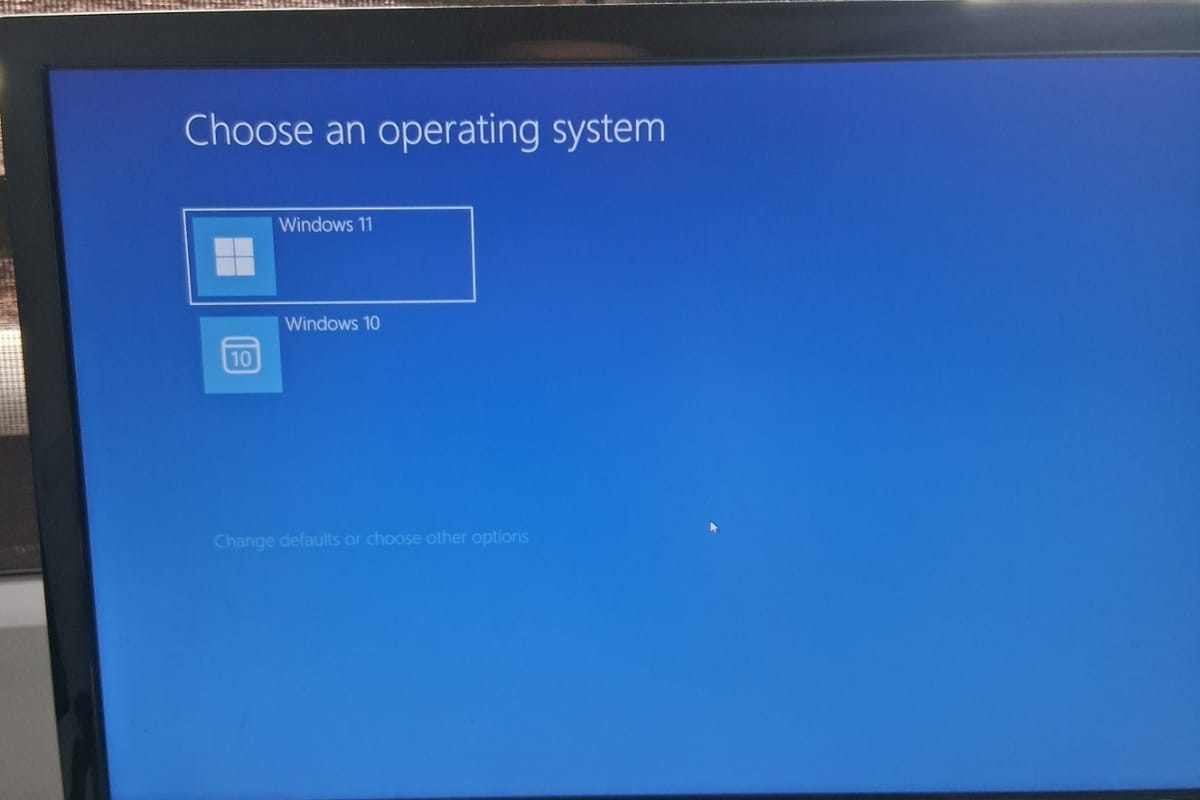
Every time I turned this computer on, before anything else had a chance to load, a blue screen asked me the same question. Choose an operating system, it said, in white letters across the top. Underneath, two names sat side by side: Windows 11 and Windows 10. Thirty seconds to decide, or it would decide for me.
I always answered the same way. Sometimes I clicked past it without really looking. Sometimes I let the clock run out and let the machine choose, because by then I already knew what I wanted and the screen, apparently, did not. I had moved to Windows 11 a long time before any of this. I had deleted the Windows 10 partition itself, taken it off the drive completely. There was nothing on that machine called Windows 10 any more. And still, every single time, the screen offered it to me as though it were sitting there waiting, a real thing I might reasonably want.
Five seconds, perhaps. That is roughly what it cost each time: the small pause, the glance at a name I had no use for, the click or the wait. Five seconds is not a number anyone budgets for. It is too small to notice, too small to complain about, and that is exactly why it survives. You never sit down and multiply it by how many mornings you have left. You just pay it, once, quietly, and get on with whatever you actually turned the computer on to do.
This afternoon I finally asked someone to look at it properly instead of living around it. An AI assistant, this time, rather than my own patience. It found the cause and cleared it in about four minutes. That part is not really the story. What was underneath it is.
Deleting an operating system, it turns out, does not delete the record of it. Somewhere in the machine's own private ledger of things it might start, there is an entry for every version of Windows it has ever known, and removing the operating system itself does nothing to that list. The entry for Windows 10 had simply gone on existing, quietly, pointing at a disk that was no longer there. When you looked at what it actually pointed to, the place where a real drive should have been named, it just said: unknown.
The chooser screen does not appear because the machine is confused about what to start. It appears whenever there is more than one entry on the list, whether or not either of them leads anywhere. So the computer was never actually uncertain. It knew exactly what it was going to start, with me or without me. It was asking me, every morning, to choose between something real and a name with nothing behind it, and it asked for no better reason than that nobody had ever told it to take the name off the list.
The two entries carry their own dates, buried in how the machine identifies them. The Windows 10 one was recorded on the seventeenth of June, 2020. The Windows 11 one on the twenty-sixth of January, 2025, which, as far as I can work out, is the day the question actually began. The machine's own log only reaches back to the twenty-ninth of December, and even inside that short stretch it has been switched on and asked the same thing on seventy-four separate days. Whatever the true number is across the whole span, it is higher than that, and there is no way now to know by how much.
It was not even only the one entry I could see. Underneath it, out of sight, there were three more, all belonging to the same dead installation: a recovery environment that Windows 10 used to fall back on, a set of disk choices that environment used to offer, and a small object left behind from putting the machine to sleep. Four ghosts in total, for an operating system that had not existed on the disk for years. I only ever saw the first one. The other three had been sitting there the whole time, unasked about, never quite in anyone's way enough to be noticed.
I keep turning the order of it over. First the thing itself goes. Then, for a long time afterwards, only the question about it remains, and the question is more patient than the thing itself ever had to be. It needs no answer today. It will happily ask again tomorrow, at exactly the same volume, and the day after that, until somebody finally goes looking for what it is actually pointing at, and finds nothing there.
Four minutes, once I looked. Five hundred and fifty-three days before I did.