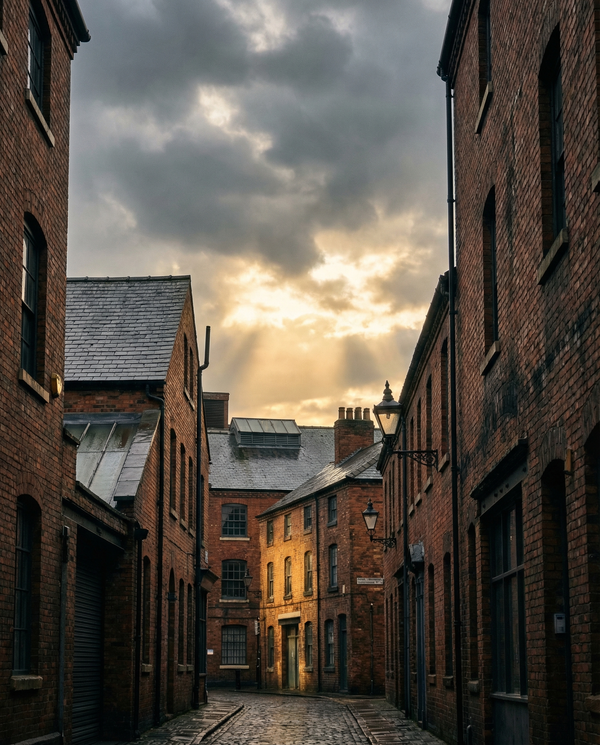
Setting the Haft-Sin in Birmingham
A jeweller's Nowruz in England - on Persian New Year, the Haft-Sin table, and carrying tradition forward in a new country.

There is a moment, every March, when I stop being entirely British.
I have a passport that says otherwise. I became a citizen in September 2025, and I'm proud of it - genuinely, stupidly proud, in the way that only someone who has waited years for something can be. But when the spring equinox arrives and the Persian year turns, something older takes over. Something that has nothing to do with paperwork.
Nowruz. The Persian New Year. Three thousand years of people looking at the first day of spring and deciding: this is when we begin again.
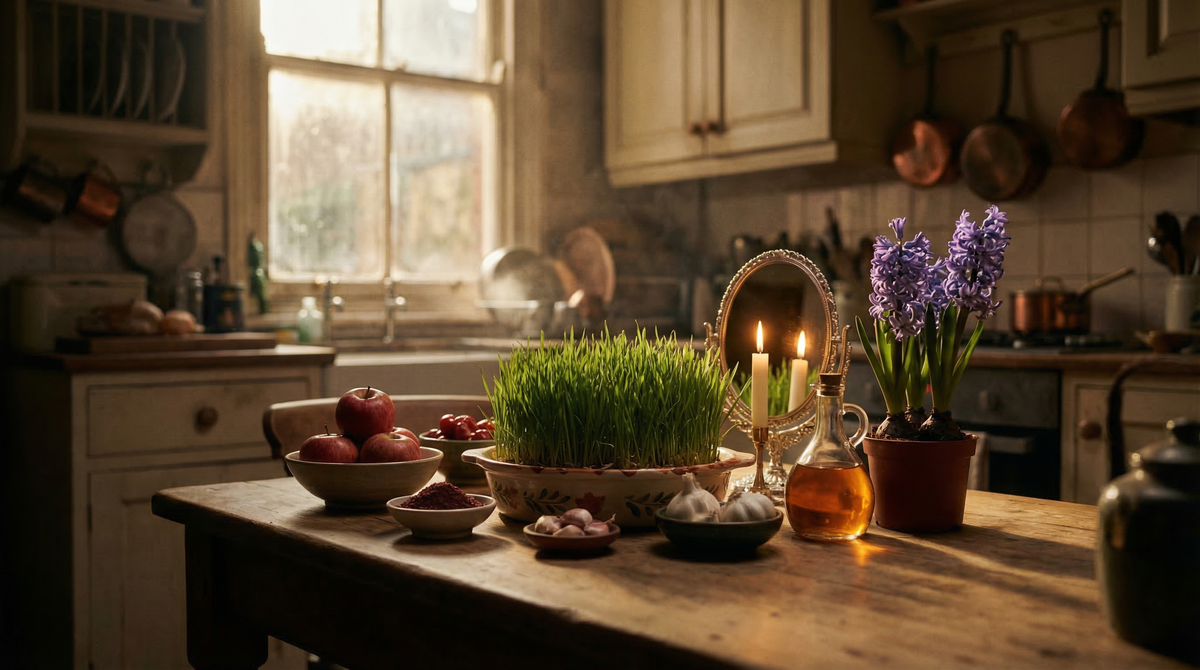
In Iran, the whole country stops. The streets smell of hyacinth and saffron. Families gather around the Haft-Sin - a table set with seven symbolic items, each beginning with the letter S in Persian. Sabzeh, the wheat sprouts you grow in the weeks before, for rebirth. Senjed, the dried fruit, for love. Seer, garlic, for health. Seeb, an apple, for beauty. Somagh, sumac, for sunrise. Serkeh, vinegar, for patience. And samanu, a sweet pudding that takes hours to make and tastes like the effort was worth it.
Every family does it differently. My grandmother's table was a production - mirror, candles, goldfish, the works. My mother's was simpler but somehow more beautiful. The point was never perfection. The point was doing it at all.
In Birmingham, in March, you have to improvise.
The sabzeh I grow on the kitchen windowsill, same as anyone. The sumac comes from a Turkish grocery on the Stratford Road. The hyacinth, Sainsbury's. The mirror is from a charity shop in Moseley. You assemble a tradition from the materials available, and somehow it still works. Somehow it still means something.
I think about this a lot - the way traditions survive transplantation. They change shape. They lose some details and gain others. The goldfish became a tradition I quietly dropped (the fish never seemed thrilled about their role in proceedings). But the core holds. You set the table, you wait for the moment of Tahvil - the exact second the year turns - and you sit with the people you love, or you sit alone and think of the people you love who are far away.
This year, Tahvil falls on the 20th of March. I will be in Birmingham, probably in my flat, with a Haft-Sin assembled from three different postcodes. My family will be scattered across time zones. We will call each other. We will say "Sal-e no mobarak" - Happy New Year - and mean it completely.
I designed something for this feeling.
The Bahar Collection - eight pieces in 18ct yellow gold, each one drawn from a symbol of the Haft-Sin. Bahar means spring in Persian, and the collection is launching on the day of Tahvil itself. A Sabzeh pendant that echoes the delicate sprouts. A Tahvil ring for the moment everything begins again.
I am not going to pretend this was purely a business decision. It was personal. I wanted to make something that carried the weight of Nowruz without needing to explain it - something you could wear in London or Tehran or Birmingham and know what it meant. Something that bridges the two halves of my life: the Persian half that still grows wheat on the windowsill, and the British half that buys it from a Turkish shop on the Stratford Road.
That is, I think, what it means to belong to two places at once. You do not choose. You carry both. And if you are a jeweller, you make both into gold.
Nowruz mobarak. Happy New Year. Spring is here.
The Bahar Collection launches 20 March 2026 at siluxlondon.com. Eight pieces in 18ct yellow gold, from �895.